Archives

Posted by on

Museums of Mallorca

Museums of Mallorca

Museums of Mallorca – Specifically the museum of Mallorca was created by decree of November 2, 1961, from the collections of the former Provincial Museum of Fine Arts, the Marroig collection, the archaeological collections owned by the State, the funds deposited by the Archaeological Society Lul liana and by the Prado Museum. Since then the funds have increased extraordinarily, divided into different sections: archeology, ethnography, fine arts and decorative and industrial arts.

The main headquarters are located in the house of the Counts of Ayamans, better known as Can Desbrull or popularly as Ca la Gran Cristiana. It has two sections in the Part Forana, the ethnological one in Muro and the monograph in Pollentia in Alcúdia.

The Museum of Mallorca is a scientific and cultural center that wants to satisfy the research, educational and play needs of the different types of users. It is also a place open to scientific research, study and consultation, learning, exploration, discovery and enjoyment, all referred to the field of history, art and culture of the island of Mallorca.

The house conserves a good part of the baroque pentagonal structure, only altered by the modifications made throughout the 19th century. In the subsoil, architectural structures from the Muslim era have also been discovered and among other remains.

The Museum of Mallorca was erected by the union of several old houses in the city of Palma.

It was not until 1976, when it opened its doors to the public: it has a height of three floors, a main portal with a semicircular arch, a noble floor with balconies and a loft with Gothic windows.
In 2010, its management resumed an underground excavation that had been carried out in the center of Palma in the late 1960s, and which continued in 1980, revealing the structures of a Muslim ceramic workshop belonging to the Almoravid dynasty, but that at that time, the works of archeology never finished.

The Museums of Mallorca have works by Francesc Comes and Joan Rosat, Gothic painters, as well as the Hispano-Flemish artists Pere Terrencs and Baltasar Buira, and the Renaissance artist Mateu López, all active in Mallorca.

Other important museums of Mallorca to visit are

  • Palau March
    The Palau opens its doors to the public as the new headquarters of the Bartolomé March Foundation with a permanent exhibition dedicated to medieval art, contemporary sculpture and the Neapolitan nativity scene. The building, located in the historic center of the city, next to the Cathedral and the Almudaina, has a museum; a public library specialized in the Balearic Islands and an auditorium. Price: 4.5 €
  • Castell de Bellver
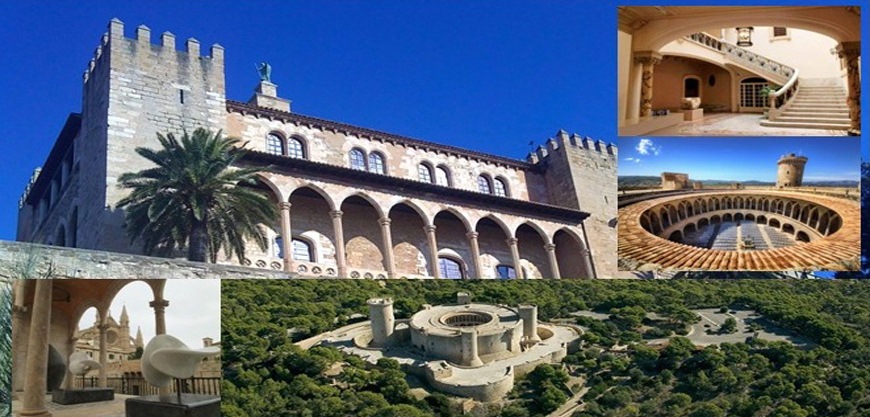
    it is located on a hill 112 meters above sea level, in an area surrounded by forest, from where you can see the city, the port, Sa Serra de Tramuntana and the Pla de Mallorca. The design of a circular floor plan with attached circular towers seems to come from the upper Herodion complex (in the West Bank), also circular and with a large master tower and three smaller towers. The smaller towers are attached and the tribute is crossed by a wall so it is attached. This building have a porch in the courtyard either. Price: € 4 and for residents € 2.50.
  • Museu d’Art Espanyol Contemporani, Fundació Juan March i d’es Baluard with a price from € 4 – € 6 and if you go by bike, you will only pay € 2.

All these museums are true works of art that have been restored and cared for over centuries and centuries in Mallorca. Totally recommended if you visit the island to take in mind a bit of historicity.
, , , Posted by on

A day in the city of Palma

A day in the city of Palma

A day in the city of Palma – a cultural city, an accessible and close city, where everything is close. Arranged like a fan facing the sea, it is imbued with cultures that have inhabited the island throughout history. Palma invites you to discover the buildings that make it up, monuments that reflect the evolution of aesthetic trends for centuries in the more than 700 streets of its historic center. There you will be able to experiance the footprints of the cultures that have been developing it. A city full of magic and light, to contemplate, to enjoy, to dream, to discover new things every day, to taste, to live.

A few recommended visits are the following:

A day in the city of Palma – The City Council in Plaza de Cort

Palma City Council (Officially and in Catalan Ajuntament de Palma), also known as Cort, is one of the four public administrations with political responsibility in the city of Palma. Its facade was declared a historical-artistic monument in 1931.

A day in the city of Palma – Arab baths

They are one of the few samples that have come to us from the Muslim architecture in Mallorca considered as an Asset of Cultural Interest and Historical Heritage of Spain. It is located in Can Serra Street, nº 7.

A day in the city of Palma – Bellver Castle

The castle of Bellver is a fortification of Gothic style. It is located about 3 km from the city of Palma de Mallorca. It was built at the beginning of the 14th century by order of King Jaime II of Mallorca and was initially used as a prison to later become a museum. It is open every day except Mondays.

A day in the city of Palma – The Lonja and the Consolado del Mar

La Lonja of Palma or Sa Llotja is one of the masterpieces of Gothic architecture in Mallorca. Located in the old town of Palma, it is a perfect place that comes alive when the night begins. Among the multitude of restaurants and shops, stand out the “Jazz Club” of San Juan Street, “Ribello” – an Italian restaurant well known in this place – and the “Abaco Coktail Bar”, “La Bóveda” or the “Opio Bar & Restaurant”.
La Llotja and the “Consolat de Mar” are two unique buildings, located next to the pier, on the Paseo de Sagrera in Palma. They were built successively between the 15th and 17th centuries and, today, they are the seat of the Presidency of the Balearic Islands. In the Consulate you will find numerous works of art and the best architecture of the Mediterranean.

A day in the city of Palma – Palace of the Almudaina

The Royal Palace of La Almudaina is one of the most important monuments of Palma de Mallorca. Built in the Muslim era, it was one of the few monuments preserved after the Christian reconquest. The Almudaina stands in front of the Cathedral of Palma forming a group of extraordinary architectural beauty together with the pond of the “Parc de la Mar” and the boulevard Paseig del Born.

All are extraordinary places typical of a wonderful island that allows us to enrich ourselves with its environment and its life.

, Posted by on

“Ses Païsses” – Mallorca

Ses Païsses

“Ses Païsses” – the talayotic village

“Ses Païsses” is located at the exit of Artà to Capdepera, inside a holm oak forest above a small hill. The archaeological site, with an antiquity of more than 3.000 years, was declared in 1946 a Historical-Artistic Monument and between 1959 and 1963 the Italian professor Giovanne Lilliu made important discoveries about its constructions.

The Talayotic town of “Ses Païsses” was formed around a central talayot with a circular floor, a building that dominates the complex fulfilling its main mission of defense and surveillance and was developed with the construction of several rooms, a hypostyle hall and a defensive wall. According to Giovanne Lilliu, the site was used until the 2nd or 1st century BC, when its inhabitants, along with those of other towns in the area, settled at the foot of the hill of Sant Salvador, where today the town of Artà is located.

Without even having left the town, at a roundabout, we will find a sign to the right. Following less than one kilometer along this local road, we will arrive at the enclosure (camí de Sa Corballa s / n), which is open to the public:

  • From November to March from 9 am to 1 pm and from 2 pm to 5 pm, Monday to Friday (Saturdays, Sundays and holidays, closed)
  • From April to October from 10 am to 1 pm and from 2:30 pm to 6:30 pm, from Monday to Saturday (including holidays).

The price for “Ses Païsses” is € 2 per entrance to this famous archaeological site of “Ses Païsses” including a tourist guide to make the itinerary. In addition, by purchasing the “Artacard” you can visit other places of cultural interest for € 3.

In order to facilitate your tour of Ses Païsses you should know that it has a parking area and also a picnic space under the shade of the sturdy oaks.

As a curiosity, in front of the door of the main entrance of the enclosure is a monolith dedicated to Miquel Costa i Llobera, poet and priest born in Pollença in 1854.

The town of “Ses Païsses” is one of the largest in Mallorca, with more than one hectare and is one of the best preserved, since its definitive abandonment, in the middle of the first century AD. it was not reoccupied, except occasionally: next to the central door was located an Arab hut and some coal activity as a lime kiln. In reality the life of the town was cut abruptly with the Roman conquest in 123 BC, but a small nucleus survived until the Romans founded a new settlement in the current town of Artà, under the Sant Salvador hill where, by the way, you can also see a Talayotic wall used as the foundation of the medieval wall.
“Ses Païsses” fell finally into oblivion but nowadays it is one of the fundamental sites to understand the way of life of the Talayotic and Balearic.

In addition, we recommend to visit also the Roman city of Pollentia. It is the most important archaeological site on the island of Mallorca and is located near Alcúdia, although its name was inherited several centuries later by the town of Pollensa.